The warning,in your language,out loud.
When the Dhansiri goes over its danger mark, Assam gets a bulletin in English and Hindi. Sixty-one percent of the state reads Assamese. The warning arrives, and it does not arrive.
No sign-up, no login, nothing to install. It asks where you are, or you pick a district.
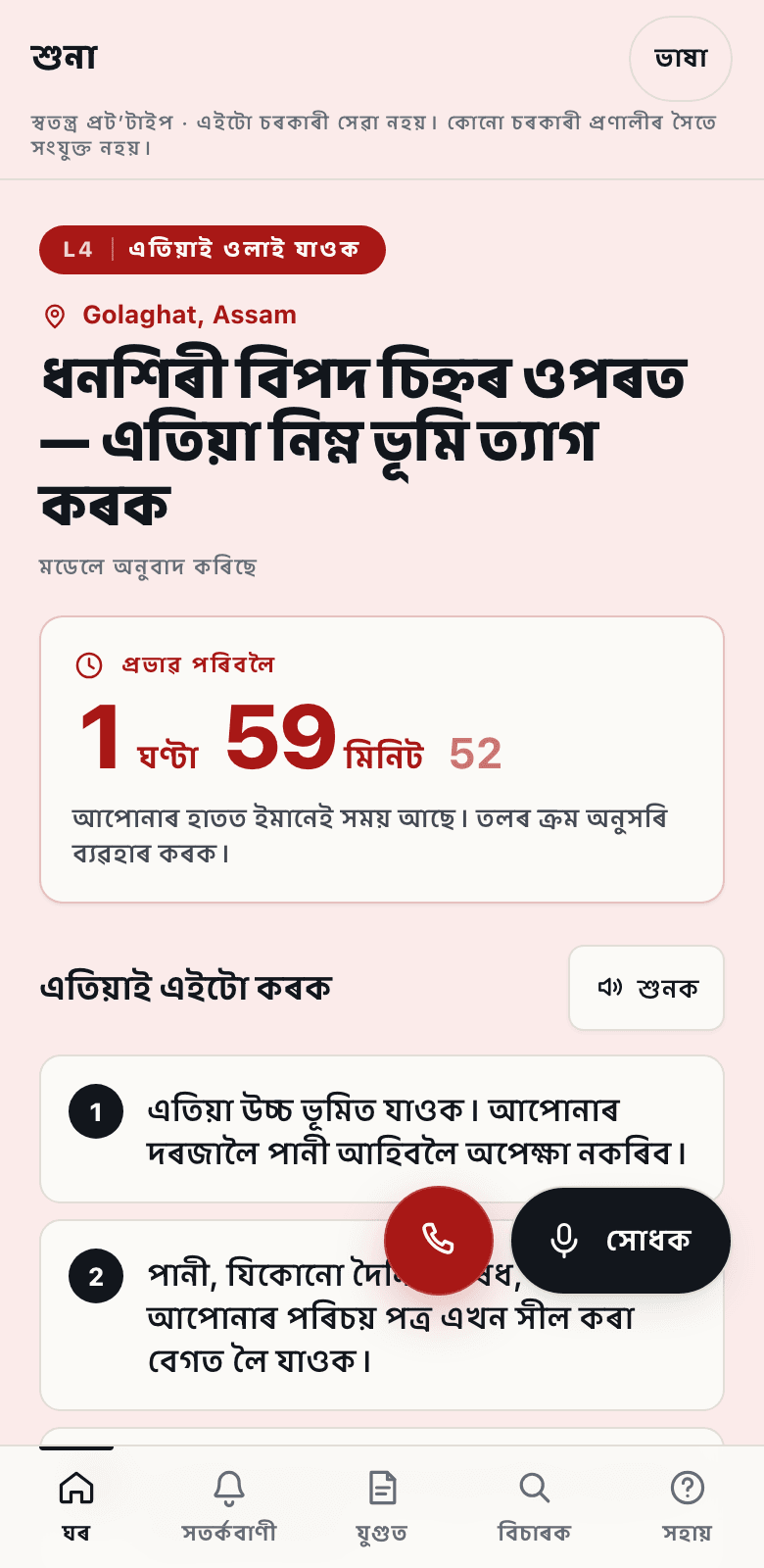
A live Level 4 warning for Golaghat, Assam — in Assamese, because the district decides the language. Real screenshot of the running build.
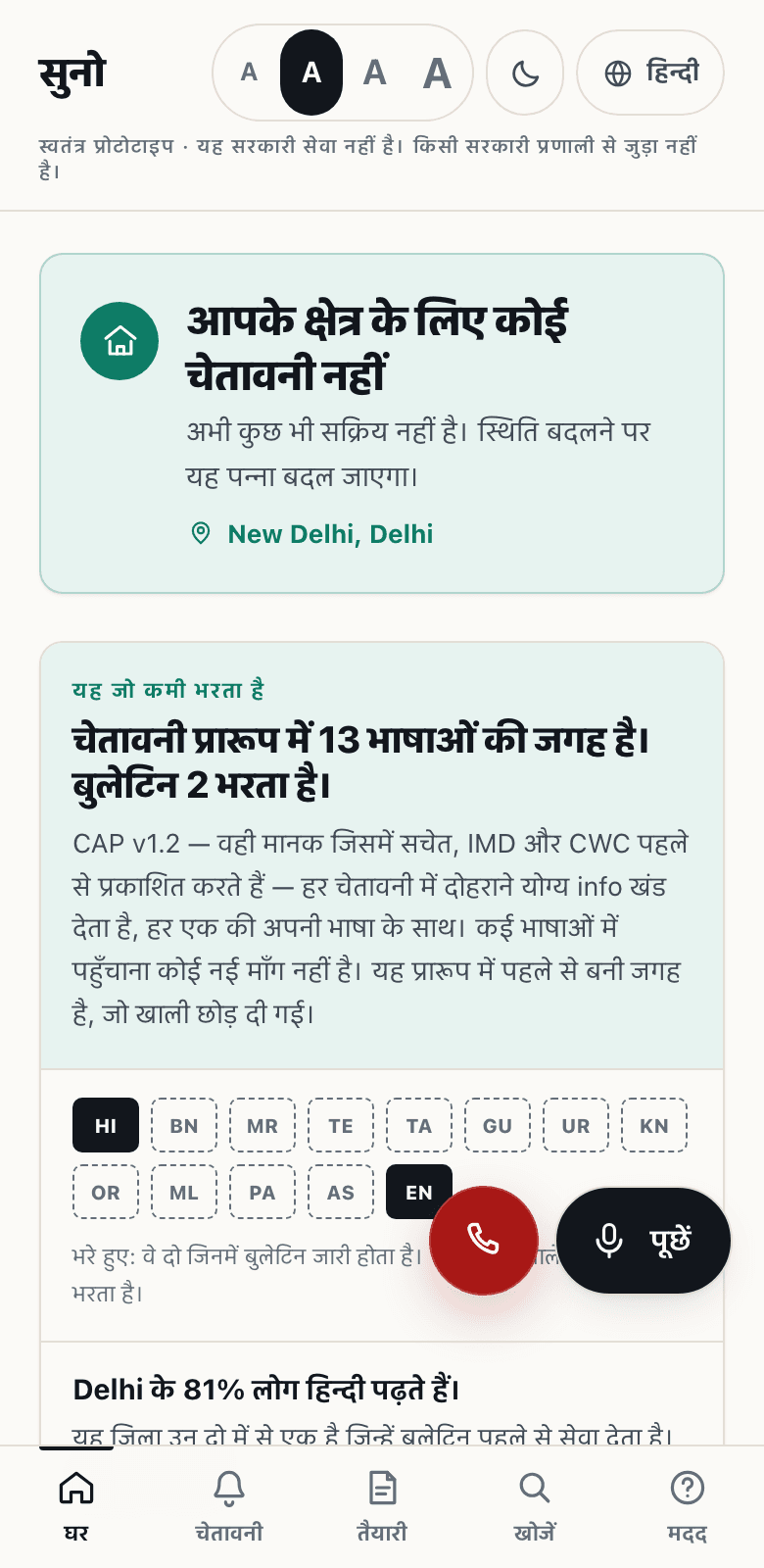
The alert format has room for 13 languages.
The bulletin fills 2.
CAP v1.2 — the OASIS standard that Sachet, IMD and CWC already publish in — gives every alert a repeating <info> block, each carrying its own <language>. Delivering an alert in many languages is not a feature anyone has to be persuaded of. It is a slot the format was designed with, and it is left empty.
The alert format carries one block per language. The bulletin fills Hindi and English. The remaining 11 — Bengali, Marathi, Telugu, Tamil, Gujarati, Urdu, Kannada, Odia, Malayalam, Punjabi, Assamese — are left empty.
Filled: the two the bulletin is issued in. Outlined: the 11 this fills, reaching a further 601 million first-language speakers.
The same product, in three states it does not choose.
Severity is derived from the district's own warnings, never set by a toggle. Each screen below is a real district: New Delhi has nothing active, Wayanad has a developing hazard, Golaghat is at Level 4. The language changes with them.
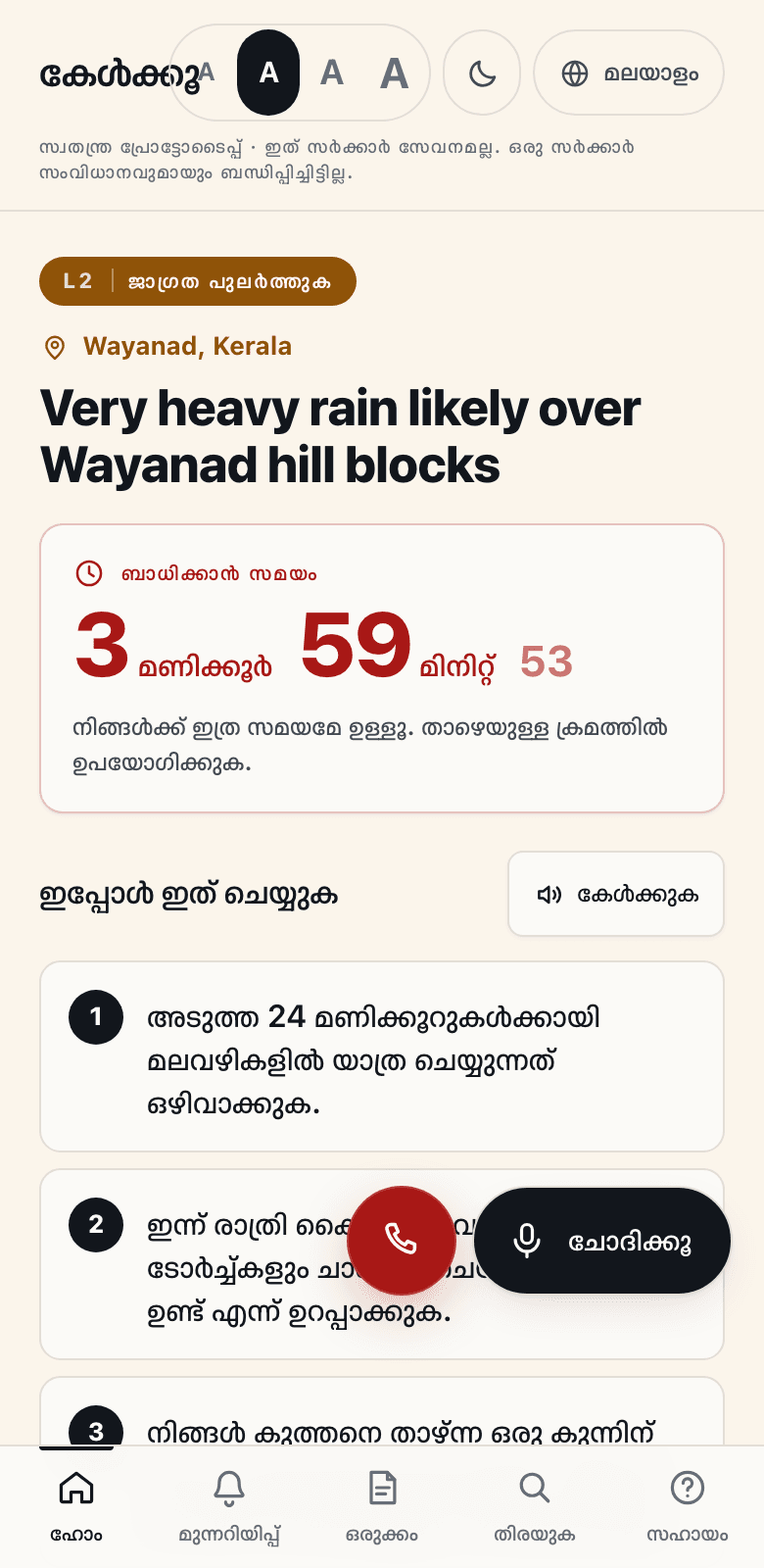
Built for a cheap Android. Not only for one.
The phone is the design target — the brief asks for people on mobile devices and slow connections, and that is who this is for. But a district control room runs on a desktop, so above 1024px it becomes a two-pane application with a persistent navigation rail rather than a phone column stranded in the middle of a monitor. Nothing is hidden at either size; only the arrangement changes.
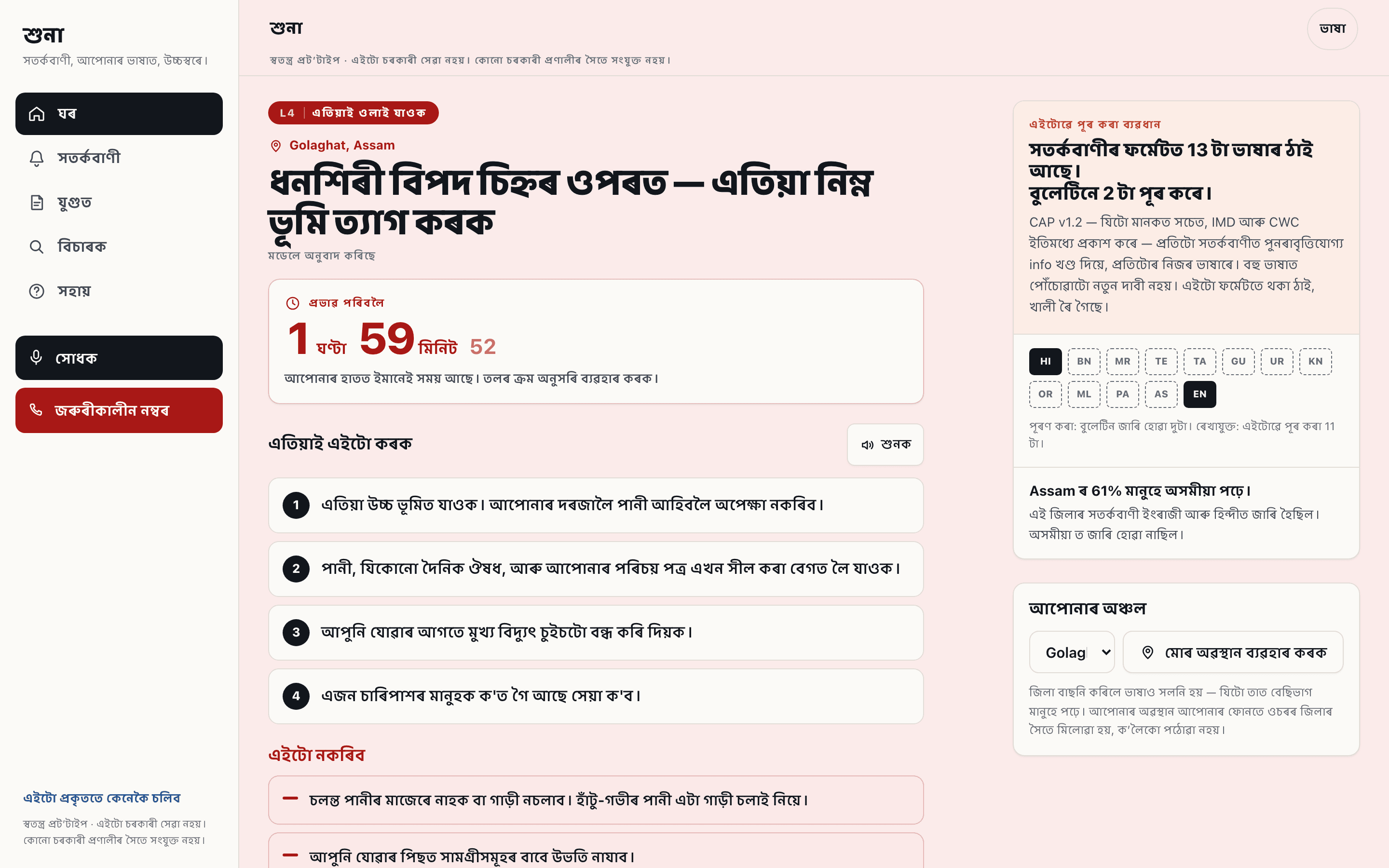
What it actually does
It speaks, and it listens
Hold the button and ask in your own language. The question goes to Whisper, because the browser's own recogniser has effectively no engine for Assamese or Odia — the languages of two of the districts warned about here. The answer is read back aloud.
A rule table answers before the model does
The twenty questions people actually ask in the first ten minutes are answered by assembling text that already exists in the dataset: identical input, identical answer, no model call, no key, no network. Only unrecognised text reaches the model.
And you can watch the validator fire
Every model reply is checked — no phone number outside the ten-number allowlist, no measurement absent from the source, no sentence telling a person they are safe. Open the assistant and run the check yourself: four poisoned answers and one correct control, through the same validator every live answer uses.
It works when the tower does not
Installable, offline, and honest about it: with no network it says so, and names the time of the last update it holds.
The severity owns the page
At Level 4 the ground itself turns red and the header collapses to one line. A red card inside a white page can be scrolled past. A red page cannot.
A CAP reader you can test yourself
Paste a real bulletin into the pipeline page and watch it parse — severity, urgency, area geocode, instructions, and the count of language blocks the sender actually filled. It runs an independent risk scan beside the official feed and publishes where the two disagree, and models what each delivery channel would and would not reach.
Every number on screen is traceable
Warnings are shaped field-for-field on CAP v1.2, the format the real agencies already publish, so replacing the synthetic feed with a live one is a parser change rather than a redesign.
What is real here, and what is not
Synthetic: all 8 warnings, all 13 shelters, every water level, wind speed and temperature, and the safety register. Sender addresses end in .invalid, a reserved domain that can never resolve.
Real: the 10 helpline numbers, your device's location if you allow it, the interface text in 13 languages, and the OpenAI calls when a key is configured.
This is not connected to any government system. It carries no government name, emblem or logo. It decides nothing, and no officer is bound by anything it says. The full item-by-item account is on How this would actually run, along with the feed it would subscribe to, who is legally allowed to order an evacuation, what breaks at national scale, and what it would cost in rupees.
Open it. It will ask where you are.
Suno — an independent prototype built for Build What Moves India. Not a government service, not affiliated with or endorsed by any agency named on this site. NDMA, IMD, CWC and NDRF are referred to only as the sources of published guidance and as the institutions this design would have to work with. All screenshots are of the running build.